Functions: Power functions and root functions
 Root equations
Here are examples where a root equation needs to be solved.
#x=1#
\[\begin{array}{rcl}\sqrt{4x+5}&=&3 \\ &&\phantom{xxx}\blue{\text{the original equation}}\\
4x+5&=&9 \\ &&\phantom{xxx}\blue{\text{both sides squared}}\\
4x&=& 4 \\ &&\phantom{xxx}\blue{\text{both sides minus }5}\\
x&=&1 \\ &&\phantom{xxx}\blue{\text{both sides divided by }4}\end{array}\]
Now we check the found solutions #x=1# by entering it into the equation:
\[\sqrt{4 \cdot 1+5}=\sqrt{9}=3\]
Hence, the solution is correct and the solution to the equation is #x=1#.
\[\begin{array}{rcl}\sqrt{4x+5}&=&3 \\ &&\phantom{xxx}\blue{\text{the original equation}}\\
4x+5&=&9 \\ &&\phantom{xxx}\blue{\text{both sides squared}}\\
4x&=& 4 \\ &&\phantom{xxx}\blue{\text{both sides minus }5}\\
x&=&1 \\ &&\phantom{xxx}\blue{\text{both sides divided by }4}\end{array}\]
Now we check the found solutions #x=1# by entering it into the equation:
\[\sqrt{4 \cdot 1+5}=\sqrt{9}=3\]
Hence, the solution is correct and the solution to the equation is #x=1#.
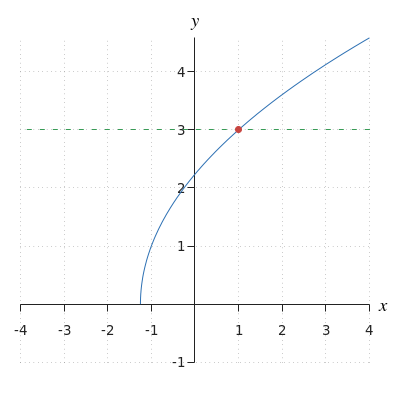
In the coordinate system below, we see the graph #f(x)=\sqrt{4x+5}# in blue (solid) and #g(x)=3# in green (dashed), and their intersection point #\rv{1,3}# in red.
In general we can solve a root equation with the following #4# steps.
Solving root equations
|
Procedure We solve a root equation for #x#. |
Example #\sqrt{x+4}+4=9# |
|
| Step 1 | Isolate the root. This means that by means of reduction we make sure the root is the only thing on one side of the equation. |
#\sqrt{x+4}=5# |
| Step 2 | Take the square on both sides to get rid of the root. |
#x+4=25# |
| Step 3 | Solve this equation. |
#x=21# |
| Step 4 | Check if the found solution is a solution to the original equation. |
#\sqrt{21+4}+4=9# Hence, the solution is correct. |
# x={{4}\over{3}} #
\[\begin{array}{rcl}
\sqrt{5}\cdot \sqrt{x}&=& \sqrt{2\cdot x+4}\\
&&\phantom{xxx}\blue{\text{original equation}}\\
5\cdot x&=&2\cdot x+4 \\
&&\phantom{xxx}\blue{\text{both sides squared}} \\
3\cdot x&=&4 \\
&&\phantom{xxx}\blue{\text{terms of }x \text{ brought to the left, constant terms brought to the right}} \\
x&=&{{4}\over{3}} \\
&&\phantom{xxx}\blue{\text{divided by the coefficient of }x} \\
\end{array}\]
\[\sqrt{5}\cdot \sqrt{{{4}\over{3}}}={{2\cdot \sqrt{5}}\over{\sqrt{3}}}\]
On the right side is:
\[\sqrt{2\cdot \left({{4}\over{3}}\right)+4}={{2\cdot \sqrt{5}}\over{\sqrt{3}}}\]
Left and right are equal, so this solution is correct.
In conclusion, the answer of the equation is # x={{4}\over{3}} #.
\[\begin{array}{rcl}
\sqrt{5}\cdot \sqrt{x}&=& \sqrt{2\cdot x+4}\\
&&\phantom{xxx}\blue{\text{original equation}}\\
5\cdot x&=&2\cdot x+4 \\
&&\phantom{xxx}\blue{\text{both sides squared}} \\
3\cdot x&=&4 \\
&&\phantom{xxx}\blue{\text{terms of }x \text{ brought to the left, constant terms brought to the right}} \\
x&=&{{4}\over{3}} \\
&&\phantom{xxx}\blue{\text{divided by the coefficient of }x} \\
\end{array}\]
Because we have taken the square, the solution for #x# that we found may not be a solution to the original equation. Therefore, we must now test the solution we found by entering it into the original equation.
On the left side is:\[\sqrt{5}\cdot \sqrt{{{4}\over{3}}}={{2\cdot \sqrt{5}}\over{\sqrt{3}}}\]
On the right side is:
\[\sqrt{2\cdot \left({{4}\over{3}}\right)+4}={{2\cdot \sqrt{5}}\over{\sqrt{3}}}\]
Left and right are equal, so this solution is correct.
In conclusion, the answer of the equation is # x={{4}\over{3}} #.
Unlock full access

Teacher access
Request a demo account. We will help you get started with our digital learning environment.