Linear Inequalities: Estimations
 One linear inequality with two unknowns
The linear inequality with unknowns #x# and #y# has the form \[ax+by+c\ge0\tiny.\]
In case you miss the sign, #\le#, remember that the equation is equivalent to (i.e., has the same solutions as) \[-ax-by-c\le0\tiny.\]
To determine which nodes in the plane meet these requirements, first draw the line #l# that is given by the equation #ax+by+c=0# .
All nodes with #ax+by+c\ge0# are on one side of the line #l# .
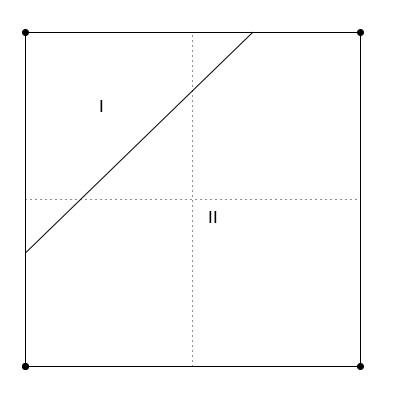
The line given by the equation #-33\cdot x+34\cdot y-553=0#, divides the plane into two areas, indicated as I and II in the figure below.
Which area is the solution of the inequality?
\[ -33\cdot x+34\cdot y-553 \lt 0 \]
Which area is the solution of the inequality?
\[ -33\cdot x+34\cdot y-553 \lt 0 \]
II
After all, the node #\rv{ 3 , -{{8}\over{3}} }# lies in this area and the value of #-33\cdot x+34\cdot y-553# at this node has the sign #-#. Consequently area II satisfies the given inequality.
The solution can be found as follows: Node #\rv{ -{{41}\over{3}} , 14 }# is in area I. The value of #-33\cdot x+34\cdot y-553# at this node has sign #+# . Consequently, #-33\cdot x+34\cdot y-553 \gt 0# is true in area I. If we move from this node to a node in area II, then the sign changes.
After all, the node #\rv{ 3 , -{{8}\over{3}} }# lies in this area and the value of #-33\cdot x+34\cdot y-553# at this node has the sign #-#. Consequently area II satisfies the given inequality.
The solution can be found as follows: Node #\rv{ -{{41}\over{3}} , 14 }# is in area I. The value of #-33\cdot x+34\cdot y-553# at this node has sign #+# . Consequently, #-33\cdot x+34\cdot y-553 \gt 0# is true in area I. If we move from this node to a node in area II, then the sign changes.
Unlock full access

Teacher access
Request a demo account. We will help you get started with our digital learning environment.